Saturday, February 28, 2009

Cain and Abel on Lost


    Religion is a common theme on LOST.  Though we may not know whom this "Jacob" is, we can all agree by now that he is some god-like figure who the others worship or answer to.  The number 108 is a sacred number to the Buddhist religion.  Mr. Echo (boy, I miss him), was known to recite passages from the Bible, especially Psalm 23.  The island itself is worshipped by some characters, almost as if it were a Garden of Eden.  We already have reference to an "Adam and Eve" on the island, referring to two skeletons found by Jack and Kate.  One of the big questions of the show (among many others) is "who are they?"  Let's leave that one for a while and think ahead.  If the island is a religious allegory and if there is an "Adam and Eve" on the show, could there by a Cain and Abel?  Is there a brother who commits fratricide somewhere on this mythical island?

    The most recent of many murders on the show was one of the most impressive and surprising scenes of the season.  In "The Life and Death of Jeremy Bentham," the most recent episode of LOST, Locke attempts to commit suicide by hanging after failing to get the Oceanic 6 back to the island.  Interrupted by Ben, Locke decides not to off himself, but is suddenly killed by Ben with the same suicidal wire after Locke expresses his instructions to see Eloise Hawking.  The look on Michael Emerson's face was like something we've never seen.  Ben was concerned.  For the first time in a long time, we saw something that might have actually been against Ben's overall plan.  It's frightening to think that the man "behind the curtain" might not be in control anymore.  He also seemed a little out-of-the-loop when he found out that Jin was still alive. 

    Obvious questions include "who is Eloise Hawking?"; "why did Ben kill Locke himself?"; "for what reason does Ben not want Locke to meet Ms. Hawking?"; and "can we still trust Ben?"  But let's ask a question that's in the back of our minds ... deep deep in the back: What is the true connection between Ben and Locke?  Richard Albert has answered to both these men as the "leader" of the Others.  Why?  What makes these men so special?  Well, let's look at it the way we would look at any religious reign of power?  How does someone get power from another?  When the father dies, the son gets the power to rule.  The older child gets the power; the younger brother gets nothing!  In most cases, this causes a battle between brothers ( such as Jacob and Esau).  I would love to open that can of worms and question whether or not there is an Esau to the island's Jacob, but let's save that for another time.

    When the figures of Cain and Abel grow up and their parents (Adam and Eve) are gone, they consistently have moral debates.  Eventually Cain murders Abel because it is obvious to him that God favors Abel, even though Cain is the older brother.  Now, we see Locke finding out things that Ben does not know.  When Ben realizes this, he kills Locke!  What a minute?  Where am I going with this?  That's right!  I predict that John Locke and Benjamin Linus are brothers!  Furthermore, if this theory is right, it supports the theory that Christian Shepherd is Jacob.  God "favors" Abel; Abel is murdered by Cain.  Christian favors Locke; Locke is murdered by Ben.  Remember when Christian said to Locke, "I said you had to move it, John."   The sacrifice made by Ben was not accepted by Christian, but the sacrifice made by Locke was.   

    How soon will we find out if this theory is right?  I think we will find out soon enough.  The question is will Ben and Locke find out (or does one of them already know)?  If they are brothers, why did Ben have Sawyer kill their father, con man Anthony Cooper?  Did Roger Linus know that his wife cheated on him with Anthony Cooper?  I think we can assume that Anthony is the true father since the kidney transplant (Locke giving his kidney to Anthony) was successful.  Of course, the world of LOST could surprise us and reveal neither Roger Linus nor Anthony Cooper as the father; Christian Shepherd might hold that title.  In the Bible, Benjamin is the son of Jacob.  All the sons of Jacob are jealous of Joseph, the favorite son.  Benjamin was the only other child by Rachel, Jacob's favorite of his many wives.  Are Locke and Ben a mix of the Joseph/Benjamin relationship and the Cain/Abel relationship?  If so, what does that say about Jack (Christian's son) or Claire (his daughter).   What does it say about Aaron???  Anyone reading might start to hate me because there are enough questions left to answer without those that would come out of this theory being true.    We have the next few weeks to find out everything that season five has to offer!  We still have some time and more theories to come! 


More predictions for the rest of the season:


  • The reason Hurley got on flight 316 is because Charlie went to convince him, hence Charlie's guitar case as Hurley's carry-on


  •  Ben succeeded in his promise to Widmore and successfully killed Penny; in an attempt to avenge Penny's death, Desmond will come back to the island and kill Ben.  Like Gandalf and Dumbledore had to die so that the true hero could save the day alone, so will our original crash victims have to get through the final season of LOST without the help of Benjamin Linus.  If this is true, I think Ben's death would be a nice Season 5 finale!


  •  Jack's grandfather, Ray, who randomly made an appearance in "316," is actually Jack.  This would require a lot of time travel explanation as to why Jack thinks that his older self is actually his grandfather, but wouldn't LOST be the show to try it?


    Stay tuned!  There are plenty more things to come out of this wonderful season of the best show on TV today!


Thursday, February 26, 2009

Text Messaging ... REALLY?

    Okay ... can we talk about something very serious for a moment?!  Text messaging has become the quickest way of communication in America and all over the world.  This, of course, is sad.  We no longer want to talk on the phone - that person we are talking to never lets us off.   We don't e-mail - it takes too long and people judge us if we don't use correct punctuation and grammar (including me).  We don't even AIM anymore - it's simply a place for us to read away messages.  The last time I IMed someone, they literally IMed back, "Who IMs anymore?"  WHAT?   I assumed that Facebook wall messages were going to be the fastest way to get a message to someone without having to get stuck "talking to them."   I was wrong.  Text messaging has become the number one way of communicating with another person.  In fact, a statistic revealed by "CellSigns" states that as of 2008, 75 billion text messages are sent in an average month.  This number has grown by 250% each year and will probably grow by 300% in the next three years. 

    If all of this is true and text messaging is going to be the main way of communication for the next few years, can we make some changes?  In order to be a fast "texter," which is a title I am usually credited with, you need to use something called T9 prediction.  I do not know why it's called T9 and I don't care.  Pretty much, T9 prediction allows you to type in a word without choosing the exact letter you need for the word.  The phone predicts what word you want.  Naturally, because there are an average of three letters per number (unless you have a full keyboard on your phone, which I don't want to get into a ridiculous rant about), there are a few possibilities as to what words can be predicted.  If the phone does not predict the right word, one needs to press the star button to get the other options.  If one uses a special word, or someone's name, you have the option to type the name way in the traditional way and then save it, personalizing your phone.  For instance, the phone predicts my wife's name as "Connie," but now the second option is "Bonnie." 

    There are many people that completely ignore the "option" button and just allow the phone to predict words for you.  This either means that they are drunk texting you or they don't care enough about you to press the damn star key!  This has led to such texts as, "Call Non.  She is pick."  What was the process of choosing the order of these words??  It's not alphabetical!  Unless these idiots think n comes before m

    Let's face it, people are generally stupid!  But the people assigned the job of choosing the order of words that come out through the prediction system need to be shot.  Who are these people?  Who thought that "non" was going to be sent through a text message more than "mom"?  Making sure my sister remembered by mother's birthday, I once sent her a text that said, "Did you send non a birthday case?"  REALLY?  Who needs to use the word "case" in a text?

    When gossiping with friends, one tends to ask things like, "Did he kiss her?"  But if you don't pay attention, you sound like a moron saying, "Did he lips her?"  Who needs the words "lips" in a text (though I will admit the irony that "lips" and "kiss" are the same buttons)?  Maybe you need to tell someone your lips are chapped.  But you know what I would say to someone who text me about their chapped lips?  "So get some fuckin chap stick and get on with your life!"  Of course, it would come out as "So get some dublin bias quick and get on with your life!"  BIAS?  Who the hell needs to say "bias" in a text message?  Furthermore, are the people using text messaging as their main form of communication discussing things such as the bias Americans has for the city of Dublin or are they saying "fuckin"?  You decide!


    "Where are you?"  (So far, so good)

    "What are you talking about?" (Nice!)

    "You were supposed to be here two hours ago."  (Still going strong ... )

    "Chamber are, I diem't get the message."  (What?)


    First of all, who in God's name talks about a chamber in a text message?  "I have your wife locked in a chamber!"  And diem't?  What the dual is that?  Sorry, I meant to say, "What the fuck is that?"  But I guess the morality of these prediction deciders forbids them from using the f-word.  And, of course, dual is a word used by so many texters when referring to two of something. 

    "I an good."  This often is sent when someone wants to tell someone else that they have reached their residence.  Why?  Because the great prediction deciders have deemed that "an" is used more often than "am."  Apparently, using "an" before a word starting with a vowel is more popular than people talking about themselves!  These people must not be American.  Then, of course, there is "good," rather than "home."  I got news for you, ladies.  If he is sending you a text message, he doesn't give a flying "dual" if you are good, but he does care if you are "home."  You know why?  He cares more about getting to where you are to "dual" you than how you are feeling!

    So, we can only hope that AT&T, Verizon, and the other companies hire smarter people for their next big breakthrough.  But until they do, be careful what you send to those people you are trying to flirt with through text messaging.  They might be confused when you tell them you want to lips them and dual them all might long (that's right, might comes before night)  Stupid shiv heads!!


Monday, February 23, 2009

Stephen Sondheim at the Kimmel Center


    Naturally, today would be the day that I would discuss the Academy Awards.  New movies, new winners, new format (was there?), and new host!  Great!  Did I cover everything?  Frankly, I was bored about an hour (I'm being generous) into it.  Heath Ledger won, which, of course, made me happy.  Though there will be many that will not accept the win as a true win because of his unfortunate death ("If he didn't die, no way would he of won").  Slumdog Millionaire took home the most prizes, including Best Picture, which was no surprise to anyone.  Hoping for an upset, I sat waiting for one of two things to happen.  First, that Benjamin Button came out on top, since I felt it was the better film.  Second, that they announced there was a mistake and The Dark Knight was given Best Picture of the Year (or decade).  Nevertheless, the awards were fine and we can move on to my real topic of the weekend ...


    On Saturday, February 21st, Bonnie and I headed to the Kimmel Center in Philadelphia, joining the numerous members of the Philadelphia Theater Community to see Frank Rich, columnist of the New York Times, interview the great Stephen Sondheim.  Bonnie and I entered the huge theater, shivered away the piercings of the cold air from outside and instantly felt at home in the huge complex.  Immediately, there was a sense that we were surrounded by "high art" musical theater lovers.  One could say there was a sense of snobbishness in the air.  There was a good number of people there that were there to see Sondheim because he is "Sondheim."  Since his lyrics are ones that many people don't "get" easily, he must be talented.  If you were to sit down and ask what their favorite Sondheim score is and why, most of them could not give you an educated answer.  I may be making grand assumptions, but this was just the impression I got.  It did not help that in the rear of the theater, there was a young man (seemed like a college voice major - possibly from the neighboring University of the Arts) singing "Being Alive," one of Mr. Sondheim's most well-known pieces.  Don't get me wrong, it's a glorious song, but it seemed to me that the Kimmel knew what they were doing.  Let him sing "Being Alive" because it's similar to a "normal musical theater song."  True Sondheim fans would want to hear "Another Hundred People" or "Finishing the Hat," but "Being Alive" will please the larger audience.  "Being Alive," while a terrific number, can be heard on any "Broadway Collection" along with "Memory" from Cats or "All That Jazz" from Chicago


    The program contained an insert that requested questions from the audience.  Bonnie and I took no time at all to write down the questions we've always wanted to ask.  Bonnie asked about his female characters.  Who were his favorite and did he have a female in his life who inspired him?  I had a feeling her question would be chosen and it was.  Sondheim immediately gave the credit to his librettist, whoever it may be.  Sondheim stated that he did not think of them as women, but as characters.  The lyrics come from who he feels the character is and what they want.  He did state that one of his favorite females characters, and one that inspired him, was Dot in Sunday in the Park With George


    My question was very specific and I felt it had little to no chance of being chosen.  I was correct.  It concerned the character arc of Sweeney Todd and the lyrics that trigger the audience's awareness of this arc.  I assume it didn't even get narrowed down to the short list that Frank Rich chose from.  It was not a problem however, for afterwards I spoke with the self-proclaimed musical theater expert, Jeffrey Simno (he backs up the title very well) and he made it abundantly clear when this awareness occurs.  Thank you, Jeffrey. 


    Mr. Rich, known for his honest columns about Art and Life and the New York Times, hurried into the interview by asking about Sondheim's popular number "Send in the Clowns."  Mr. Sondheim told a humerus (and brutally honest) tale about the making of the film adaptation of A Little Night Music, the show from which "Clowns" comes from.  He spoke of his distaste for the film version ("Though there were a few good moments," he said) and about Elizabeth Taylor's hard time recording "Send in the Clowns" for the soundtrack.  According to the composer, Taylor recorded the song around 73 times and the recording engineers had to piece the final product together, not just line by line, but often syllable by syllable.  "Okay, take the s-sound from that take and combine it with the end-sound from that take..."  Sounds brutal and was, apparently, not worth the effort.


    Mr. Rich continued the interview with very interesting questions.  Topic highlights included the recent revival of West Side Story, which Mr. Sondheim is looking forward to in the bi-lingual format.  He enjoys the fact that "I Feel Pretty," a lyric he is not a fan of, will now be listened to by an audience whose majority will not understand the lyrics, and be forced to pay attention to the joyful melody.  He expressed concern about the format because certain songs such as "America" need to be sung in English because the rhymes are the joke.  A decision has yet to be made on whether "I Have a Love" will be sung in Spanish or English.  Mr. Sondheim did say, however, that it would be justifiable to have Anita sing her song, "A Boy Like That," in Spanish and Maria sing "I Have a Love" in English, showing us the transport of Maria's love to an American, English-speaking boy.  Anita joining her in English would express the moment when Anita understands the love Maria has for Tony, therefore progressing the play to its tragic end. 


    Mr. Sondheim spoke about the term genius.  His definition was short and clear.  "A genius is one who never stops inventing."  He went on to say that the only "genius" he believes he has ever met is Jerome Robbins, legendary choreographer and director, who first worked with Sondheim on West Side Story.  "He never stopped inventing.  And not just theatrical ideas, but whenever he were at a party, he would make up games.  Good games.  We actually would play the games right there and have a good time."  Sondheim's calling Robbins a genius is quite an honor, considering Sondheim went on to discuss working so closely with his mentor, Oscar Hammerstein II. 


    Though not a main topic of the discussion, Mr. Sondheim did talk about the work he did with Hammerstein and did give Carousel the credit of being his second-favorite musical.  His favorite musical credit goes to George and Ira Gershwin's Porgy and Bess.  Mr. Sondheim discussed how lyric writing was a skill that could be taught in 20 minutes ("or even five minutes"), but takes longer to be acquired.  It was obvious to me that Sondheim could hear the voice of Hammerstein in his head as he spoke these words to the captive audience. 


    When asked by an audience member about his experiences with Cole Porter, Sondheim immediately smiled as if his memory of the legendary composer and lyricist (one of the few musical theater legends to have both credits, along with Mr. Sondheim) was splendid.  He spoke of his first meeting.  As a young composer, Mr. Sondheim travelled to Porter's house to do research on a satire he was writing.  The satire was on Porter's writing style.  Upon entering with muddy feet, Sondheim read a sign at the door that read, "Please wipe feet.  White carpets."   Obviously putting him on edge, Sondheim took his shoes off and entered a room with a piano "the size of this stage."  Before Porter entered, he tried to read what he was currently composing, but was interrupted by the composer's entrance.  Porter requested to hear what Sondheim had written so far.  Sondheim played and was corrected by Porter about the ending.  Essentially, Cole Porter helped Sondheim write a satire about Cole Porter.  "That's the kind of guy he was," said Sondheim, laughing. 


    He continued to tell a story about an experience while working on Gypsy.  During the process, Ethel Merman, a close, personal friend of Porter's told the production team that Porter had just had his second leg amputated and was in low spirits and asked if the team would mind if visiting Porter to share some selections with him.  They all agreed.  Mr. Sondheim recalls what he claimed was one of his happiest memories.  He was playing "Wherever We Go," a number clearly influenced by Cole Porter, and got to the section that goes, "No fits, no fights, no feuds, and no egos ... amigos ... Together!"  As the word "amigos" was sung, Sondheim heard Porter gasp in pleasured shock at the extra rhyme that Sondheim had placed in the line using another language, something Porter did often.  Sondheim knew of Porter's joy and considers it a triumph.


    Though he was only seen by me from the view of an audience, Mr. Sondheim seemed to be having a one-on-one conversation with each and every person.  His casualness made us all forget for a moment that we were seeing a legend, and made us feel like we were seeing a human who has worked his whole life and, though has achieved greatness, still wants more for himself, like any other human being.  Like us, he has opinions about musicals.  A particularly fascinating moment was when he expressed his dislike of the work of the musical-writing team of Lerner and Lowe.  "They're good ... it's just ... not my type ... not my cup of tea."  Just because someone is "known as a great composer" does not mean we all have to agree on their talent.  In a way, I felt Sondheim was telling us that it's okay if we do not like everything he does.  His sense of security shows that he would be alright with that if it were the case.  The way he spoke of his co-workers in the field helped us relate his stories of famous legends to our own lives.  He humanized figures such as Bernadette Peters, Angela Lansbury, and even Oscar Hammerstein by telling us tales of their insecurities, failures, and ultimate triumphs. 


    Though this may have only been a "moment ... one peculiar, passing moment,"  Sondheim is now not only an influential composer, but a teacher - a teacher of music, creativity, and life lessons.  So, let's "leave the moment, just be glad for the moment that we had ..." with Mr. Stephen Sondheim.  Thank you, Mr. Sondheim, for the music, the lyrics, and the moments. 


Thursday, January 22, 2009

Once Again ... A Comic Book Snub!

2008 was a good year for films. Seriously, think about it! Did we not all run to the theater to laugh at Robert Downy Jr. in Tropic Thunder (with a terrific cameo by Tom Cruise)? Did we not all marvel at Meryl Streep’s portrayal of a nun with a secret in Doubt (some of us marveled at her performance in Mamma Mia … SOME!)? Did we not all trudge into theaters to see how they would actually make Brad Pitt’s Benjamin Button grow young? But, most importantly, did we not show up in droves to see the most anticipated film of the year The Dark Knight? Why then are all of the movies above nominated for awards such as Best Picture, Actor, and Actress and The Dark Knight snubbed for major awards (with the exception of Heath Ledger). Seriously, people, why was The Dark Knight snubbed when it came to Best Motion Picture of the Year?

First of all, Heath Ledger’s nomination is no excuse for the lack of a nod in the Best Picture category. He was beyond brilliant. This nomination should not be considered a make-up for Best Picture. Let us not lessen the performance by making such a claim!

Why are “Comic Book” movies always snubbed at Oscar Time? For what reason do we not take these movies seriously? Of course, there are comic book movies that have no business having Oscar’s on their mantles, but sometimes exploring the story of a comic book legend is worth awarding with the gold. The Dark Knight is a prime example. This film did not simply tell the story of Batman vs. The Joker, like we’ve seen before. This explored the psychology of two of fictions greatest characters and of the audience. Ask yourself the question: would you have blown up the other boat (those of you that saw The Dark Knight know what that's about)?

This is the biggest disappointment in Oscar history as far as comic book films are concerned. We’ve seen great films get ignored before, but this film went above and beyond the typical action and explosions of the past. In fact, did anyone walk out thinking, “Boy, that Bat-Pod was awesome!”? No! We walked out questioning ourselves and what we would do if we had the responsibility of Batman. We thought about how a savior can be challenged by one man. We questioned the theory of chaos and discovered it truly is fear.

It’s worth looking at some other films that have been ignored in the past. Audiences of 2002 were captivated by Marvel’s greatest hero, Spider-Man. In Spider-Man, director Sam Raimi delves deep into the famous quote, “With great power, comes great responsibility,” making Spider-Man not only a metaphor for teenagers to relate to, but a symbol of political figures all over the world. How much power is too much power? Taking on power and mixing it with love and villainy, Raimi gets a great story along with a vision masterpiece. He also gets two terrific performances out of Toby McGuire and Kirsten Dunce (possibly the best of their respective careers).

While Tim Burton’s 1989 Batman may not have dealt with the issues of The Dark Knight, it still reclaimed the Batman origin and brought back the darkness and depth that the 1960’s Batman had all but destroyed. In the year 1989, the nominees for Best Picture included Driving Miss Daisy, which won, Dead Poet’s Society, Born on the Fourth of July, My Left Foot, and Field of Dreams. All of these were terrific films with outstanding direction and performances. Field Of Dreams is a beautiful film about the common man and his family. It rarely fails to make even the strongest man tear up, but was it worthy of a BEST PICTURE nomination? It was definitely not better produced than Tim Burton’s Batman. Not to mention, the lack of nomination for Best Supporting Actor: Jack Nicholson as the Joker. Bringing together a clever mix of the 70’s Joker and Caesar Romero’s Joker, Nicholson gave us the Joker that was incredibly appropriate for 1989, taking us away from the comical interpretation of Gene Hackman’s comic book villain and bringing us into the 1990s.

After Burton blew us away with Batman, Warren Beatty saw an opening for the next great comic book blockbuster: Dick Tracy. At least the Academy has enough sense to award Al Pacino a nomination for this brilliant portrayal of Big Boy Caprice, Tracy’s main adversary (he deserving lost to Joe Pesci’s amazing performance in Goodfellas). The film, however, was ignored by the academy. Beatty’s vision of the film, mixing the 1950’s comic style with the 1990’s contemporary edge, revitalized a figure that had been lost of that generation of teens. The film was quite successful; it even brought back the cartoon, a presentation that would typically be considered corny and outdated. With stylized acting and a top-notch cast, Dick Tracy introduced the true “comic” detective to a new audience. The film is still a favorite among comic fans, though, oddly, no sequel was ever attempted. Where was this film in the Best Picture category?

Some other snubs from comic book films:
- Marlon Brando for Best Supporting Actor in Superman (come on!)
- Warren Beatty for Best Director of Dick Tracy
- Christopher Nolan for Best Director of The Dark Knight and (perhaps) for Batman Begins
- Tim Burton for Best Director of Batman
- Richard Donner for Superman (his cut of Superman II should be given an honorary Oscar)

And the award goes to … anything but the comic movie, even if the comic movie is actually a good movie! Let’s stop giving nominations and awards to the same type of films. Let’s look outside the box and give awards to the films that are encouraging audiences to think more intelligently about things they are already thinking about. Perhaps the decision makers are not ready to think inside the comic box.

Wednesday, December 24, 2008

Gotham ...

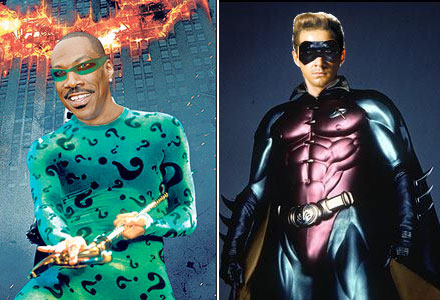
The rumors have started! Now that the DVD of Christopher Nolan's masterpiece The Dark Knight is a best-seller, people are scrambling for news about the inevitable third chapter to Nolan's saga. So far, the crazy rumors include Angelina Jolie and Rachel Weisz in talks for the role of Catwoman, Shia LaBeouf as Robin, and Eddie Murphy as the Riddler. These rumors have been rebutted by many of the higher-ups in Warner Bros and Murphy's representatives have stated that the comedic actor denies being offered the role. Nothing has been heard about the other rumors.

The actual idea that Catwoman would be in the movie is silly. First of all, Nolan has created a franchise based on reality. Though far-fetched, nothing he has created is impossible in the "real world." Catwoman, like the Penguin, seems to be a little out of the realm of the Gotham (the working title of the sequel, by the way) created by Nolan. Obviously, fans would like to see Catwoman, but it seems unlikely for Nolan to enter that world.

Christian Bale has made it very clear that if Robin appears in the film, he will not be reprising the role of the Caped Crusader. He is correct in feeling this way. Bruce Wayne is still adjusting to his role as the Batman and is not yet ready to have a young protege. Not to mention Bruce Wayne is not much older than Dick Grayson should be when he dons the Robin mantle.

Now, Eddie Murphy as the Riddler was a rumor worth getting excited about. I was interested a few months ago when I read that Johnny Depp was in talks for the role, but the more and more I thought about it, Depp is an obvious choice. While Nolan would want to move away from the wackiness of Frank Gorshin and Jim Carrey, Depp's darkness might be too dark for his vision of the Riddler. Eddie Murphy, on the other hand, is an actor who can probably handle the combination of evil and cleverness needed for Batman's smartest enemy. Let's also acknowledge something that has not yet been said: it's about time an African American take on a role as one of the Batman villains. Why does Batman only fight the white criminals of Gotham? At the very least, it would make for an interesting interpretation.

As said before, the next movie should focus on the media. How does the media affect Gotham's view of Batman, now being searched for by Gotham's finest? Nolan could easily explore the power of the press, much like he explored the power (or lack thereof) of the politics in Gotham City with The Dark Knight. This would be a terrific way to explore the Riddler, a villain without brawn, but plenty of brains. It would also be a beautiful way to introduce Bruce Wayne's love interest, Vicki Vale. Now that Rachel Dawes is clearly not coming back, Wayne can explore a love/hate relationship with photojournalist Vicki Vale. Who will she love? Batman? Bruce Wayne? Which one will she hate?

Hopefully, Murphy's denial of the rumor is the actual rumor. Murphy would be a nice choice to play Edward Nigma a.k.a. The Riddler. Remember how people doubted the unconventional choice of Heath Ledger? Haven't we learned to trust Christopher Nolan yet?

Sunday, October 19, 2008

Our State Fair ...

As a student of musical theater, and a current teacher of theater in a high school, I find myself constantly being reminded that the "old musical" is becoming more and more dated. While I am a fan of the modern musical (started by the great Stephen Sondheim), I cannot help but melt when I am taken away by a classic musical. I recently showed my theater class the film version of Carousel, the musical that I consider Rodger and Hammerstein's greatest achievement. While they understood the fact that the musical is "dated," they were surprisingly receptive to the plot and characters. It was refreshing to see that these musicals were not dead to a group of teenagers.

I had an even greater moment last night when I had the chance to see State Fair at the Walnut Street Theater, located in Philadelphia, and the oldest non-profit theater in the country. Having seen the movie version close to ten years ago, I had no real interest in seeing the production. I do love Rodger and Hammerstein's musicals, but I had a feeling this one was going to be too light and fluffy for my tastes.

I was pleasantly surprised to experience one of the best nights I've had in the theater in a long while. While the productions was stunning with a great set, terrific direction, a spectacular cast, and exciting choreography, it was the work itself that I enjoyed the most. While not one of R&H's most well-known works, the music of State Fair was just as catchy and interesting than that of King and I, Oklahoma, and South Pacific. In fact, it was stronger than the music of Sound Of Music, still argued by some to be the best of their works. It was filled with drama, comedy (still funny in 2008), love, and some of the greatest damn songs heard by this lover of musical theater in a long time.

Of course, "It Might As Well Be Spring" is the most known song. But the show is filled with other terrific songs such as "That's For Me" and the show-stopper "All I Owe Ioway," a number just as good as "June is Bustin' Out All Over," if not stronger.

The musical takes a very interesting turn when one of the females characters reveals to her lover that she is married, and unlike a typical musical from 1945, the lovers don't make up. The exit following her confession is her last one, leaving the audience struggling with emotion. We want the lovers we've seen the whole show together, but we can't help but dislike her for being unfaithful to her husband, and leaving the young lover in tears over her dishonesty. It's inspiring to know that Rodgers and Hammerstein were writing such controversial work, even during the conservative years of the 1940s.

Nothing puts me in a better mood than knowing that the love I have for old musicals is shared by others. The audience obviously loved every minute of it as much as I did. The Walnut has proved that the "old-school musical" is still alive and well, influencing modern writers to work hard at making their works shine as much as the greats of the Golden Age!

Sunday, September 28, 2008

The Frienemy

Recently, my honors English class was having a discussion about friendship. We are currently reading A Separate Peace by John Knowles. It is a story of two young men in a prep school in New England in 1942. The narrator, Gene, tells the story of he and his friend, Phineas (Finny), and how their friendship goes through a series of ups and downs. In the story, Gene grows to love and hate Finny all at the same time. In class, we discussed how relevant this book is to high school students in 2008.

My students came up with some very interesting things. I asked, "Does anyone have a friend that, deep down inside, you actually hate?" I used hate, which is a strong word, hoping that my students would go on to explain that hate is the wrong word. Instead, most nodded their heads and completely and openly acknowledged the fact that they all have a friend such as the one that I described. "A frienemy?" one girl asked, "do you mean a frienemy?" I actually knew what the young lady was talking about, but I wanted to hear her definition so I played dumb and asked her to explain.

"A frienemy is a person who we are friends with, but actually keep around in order to get their approval or to be present for their eventually downfall." I was amazed at this incredibly well thought out definition. She and the rest of the class continued to explain that these people are important to us because they make us feel important. Apparently, if there in someone is the world we hate that much, it gives us a goal of what not to be.

The conversation continued and out of curiosity I asked, "Do any of you think you are a friend of someone that actually hates you." The majority of the class - boys and girls - said yes. "How does that make you feel?"

Another girl, usually very quiet, raised her hand quicker than anyone in the class and said, "It makes me feel important. If someone hates me that much, I must be very important to a decent amount of people." I didn't know if I was more impressed or scared with the logic.

Is this what high school students are going through? I often value my age in the classroom because I feel like I still remember what it was like to be a teenager. I can relate to my students on a certain level. I am only ten years older. Could I forget this quickly? Or is it simply that things really have changed that much? I don't remember having friends I hated. I felt life was too short to be with people I wasn't very fond of. It was for this reason that I had a small, close-knit group of friends who I loved and still keep in contact with. I didn't need to prove myself to anyone and, for this reason, I was pretty well-liked. What has changed that fourteen- and fifteen-year-old kids think that they need to be hated to be important?

Something needs to be done for these students to make them realize that what defines them will not be who hated them or who they hated. What will define the students of this generation will be what they achieve and how they achieve it. While I love that my students are relating to the novel, it scares me to think that this extreme case in the story seems to be the regular in 2008 high schools. As teachers, we need to teach more lessons about life. We have experienced it. We've made the mistakes and it is our duty to inform students that these "frienemies" will not help them get into college and grad school. They will not help them find work in a suffering economy. They will not help their credit score or get them the mortgage approval they will need in a short nine to ten years. This conversation, that started as a simple book discussion, really opened my eyes to what is going on inside the heads of my students. We need to pay more attention to what they are exposed to. Furthermore, we need to make our volume louder than the volume of the society that is telling them to "love thy frienemy!"