

2008 was a good year for films. Seriously, think about it! Did we not all run to the theater to laugh at Robert Downy Jr. in Tropic Thunder (with a terrific cameo by Tom Cruise)? Did we not all marvel at Meryl Streep’s portrayal of a nun with a secret in Doubt (some of us marveled at her performance in Mamma Mia … SOME!)? Did we not all trudge into theaters to see how they would actually make Brad Pitt’s Benjamin Button grow young? But, most importantly, did we not show up in droves to see the most anticipated film of the year The Dark Knight? Why then are all of the movies above nominated for awards such as Best Picture, Actor, and Actress and The Dark Knight snubbed for major awards (with the exception of Heath Ledger). Seriously, people, why was The Dark Knight snubbed when it came to Best Motion Picture of the Year?
First of all, Heath Ledger’s nomination is no excuse for the lack of a nod in the Best Picture category. He was beyond brilliant. This nomination should not be considered a make-up for Best Picture. Let us not lessen the performance by making such a claim!
Why are “Comic Book” movies always snubbed at Oscar Time? For what reason do we not take these movies seriously? Of course, there are comic book movies that have no business having Oscar’s on their mantles, but sometimes exploring the story of a comic book legend is worth awarding with the gold. The Dark Knight is a prime example. This film did not simply tell the story of Batman vs. The Joker, like we’ve seen before. This explored the psychology of two of fictions greatest characters and of the audience. Ask yourself the question: would you have blown up the other boat (those of you that saw The Dark Knight know what that's about)?
This is the biggest disappointment in Oscar history as far as comic book films are concerned. We’ve seen great films get ignored before, but this film went above and beyond the typical action and explosions of the past. In fact, did anyone walk out thinking, “Boy, that Bat-Pod was awesome!”? No! We walked out questioning ourselves and what we would do if we had the responsibility of Batman. We thought about how a savior can be challenged by one man. We questioned the theory of chaos and discovered it truly is fear.
It’s worth looking at some other films that have been ignored in the past. Audiences of 2002 were captivated by Marvel’s greatest hero, Spider-Man. In Spider-Man, director Sam Raimi delves deep into the famous quote, “With great power, comes great responsibility,” making Spider-Man not only a metaphor for teenagers to relate to, but a symbol of political figures all over the world. How much power is too much power? Taking on power and mixing it with love and villainy, Raimi gets a great story along with a vision masterpiece. He also gets two terrific performances out of Toby McGuire and Kirsten Dunce (possibly the best of their respective careers).
While Tim Burton’s 1989 Batman may not have dealt with the issues of The Dark Knight, it still reclaimed the Batman origin and brought back the darkness and depth that the 1960’s Batman had all but destroyed. In the year 1989, the nominees for Best Picture included Driving Miss Daisy, which won, Dead Poet’s Society, Born on the Fourth of July, My Left Foot, and Field of Dreams. All of these were terrific films with outstanding direction and performances. Field Of Dreams is a beautiful film about the common man and his family. It rarely fails to make even the strongest man tear up, but was it worthy of a BEST PICTURE nomination? It was definitely not better produced than Tim Burton’s Batman. Not to mention, the lack of nomination for Best Supporting Actor: Jack Nicholson as the Joker. Bringing together a clever mix of the 70’s Joker and Caesar Romero’s Joker, Nicholson gave us the Joker that was incredibly appropriate for 1989, taking us away from the comical interpretation of Gene Hackman’s comic book villain and bringing us into the 1990s.
After Burton blew us away with Batman, Warren Beatty saw an opening for the next great comic book blockbuster: Dick Tracy. At least the Academy has enough sense to award Al Pacino a nomination for this brilliant portrayal of Big Boy Caprice, Tracy’s main adversary (he deserving lost to Joe Pesci’s amazing performance in Goodfellas). The film, however, was ignored by the academy. Beatty’s vision of the film, mixing the 1950’s comic style with the 1990’s contemporary edge, revitalized a figure that had been lost of that generation of teens. The film was quite successful; it even brought back the cartoon, a presentation that would typically be considered corny and outdated. With stylized acting and a top-notch cast, Dick Tracy introduced the true “comic” detective to a new audience. The film is still a favorite among comic fans, though, oddly, no sequel was ever attempted. Where was this film in the Best Picture category?
Some other snubs from comic book films:
- Marlon Brando for Best Supporting Actor in Superman (come on!)
- Warren Beatty for Best Director of Dick Tracy
- Christopher Nolan for Best Director of The Dark Knight and (perhaps) for Batman Begins
- Tim Burton for Best Director of Batman
- Richard Donner for Superman (his cut of Superman II should be given an honorary Oscar)
And the award goes to … anything but the comic movie, even if the comic movie is actually a good movie! Let’s stop giving nominations and awards to the same type of films. Let’s look outside the box and give awards to the films that are encouraging audiences to think more intelligently about things they are already thinking about. Perhaps the decision makers are not ready to think inside the comic box.
Thursday, January 22, 2009

Wednesday, December 24, 2008
Gotham ...
The rumors have started! Now that the DVD of Christopher Nolan's masterpiece The Dark Knight is a best-seller, people are scrambling for news about the inevitable third chapter to Nolan's saga. So far, the crazy rumors include Angelina Jolie and Rachel Weisz in talks for the role of Catwoman, Shia LaBeouf as Robin, and Eddie Murphy as the Riddler. These rumors have been rebutted by many of the higher-ups in Warner Bros and Murphy's representatives have stated that the comedic actor denies being offered the role. Nothing has been heard about the other rumors.
The actual idea that Catwoman would be in the movie is silly. First of all, Nolan has created a franchise based on reality. Though far-fetched, nothing he has created is impossible in the "real world." Catwoman, like the Penguin, seems to be a little out of the realm of the Gotham (the working title of the sequel, by the way) created by Nolan. Obviously, fans would like to see Catwoman, but it seems unlikely for Nolan to enter that world.
Christian Bale has made it very clear that if Robin appears in the film, he will not be reprising the role of the Caped Crusader. He is correct in feeling this way. Bruce Wayne is still adjusting to his role as the Batman and is not yet ready to have a young protege. Not to mention Bruce Wayne is not much older than Dick Grayson should be when he dons the Robin mantle.

Now, Eddie Murphy as the Riddler was a rumor worth getting excited about. I was interested a few months ago when I read that Johnny Depp was in talks for the role, but the more and more I thought about it, Depp is an obvious choice. While Nolan would want to move away from the wackiness of Frank Gorshin and Jim Carrey, Depp's darkness might be too dark for his vision of the Riddler. Eddie Murphy, on the other hand, is an actor who can probably handle the combination of evil and cleverness needed for Batman's smartest enemy. Let's also acknowledge something that has not yet been said: it's about time an African American take on a role as one of the Batman villains. Why does Batman only fight the white criminals of Gotham? At the very least, it would make for an interesting interpretation.
As said before, the next movie should focus on the media. How does the media affect Gotham's view of Batman, now being searched for by Gotham's finest? Nolan could easily explore the power of the press, much like he explored the power (or lack thereof) of the politics in Gotham City with The Dark Knight. This would be a terrific way to explore the Riddler, a villain without brawn, but plenty of brains. It would also be a beautiful way to introduce Bruce Wayne's love interest, Vicki Vale. Now that Rachel Dawes is clearly not coming back, Wayne can explore a love/hate relationship with photojournalist Vicki Vale. Who will she love? Batman? Bruce Wayne? Which one will she hate?
Hopefully, Murphy's denial of the rumor is the actual rumor. Murphy would be a nice choice to play Edward Nigma a.k.a. The Riddler. Remember how people doubted the unconventional choice of Heath Ledger? Haven't we learned to trust Christopher Nolan yet?
The actual idea that Catwoman would be in the movie is silly. First of all, Nolan has created a franchise based on reality. Though far-fetched, nothing he has created is impossible in the "real world." Catwoman, like the Penguin, seems to be a little out of the realm of the Gotham (the working title of the sequel, by the way) created by Nolan. Obviously, fans would like to see Catwoman, but it seems unlikely for Nolan to enter that world.
Christian Bale has made it very clear that if Robin appears in the film, he will not be reprising the role of the Caped Crusader. He is correct in feeling this way. Bruce Wayne is still adjusting to his role as the Batman and is not yet ready to have a young protege. Not to mention Bruce Wayne is not much older than Dick Grayson should be when he dons the Robin mantle.
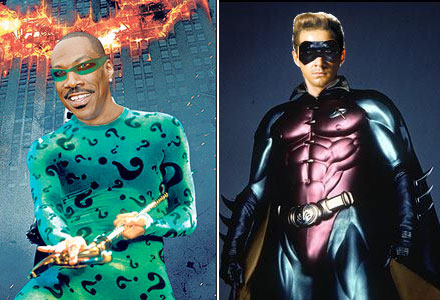
Now, Eddie Murphy as the Riddler was a rumor worth getting excited about. I was interested a few months ago when I read that Johnny Depp was in talks for the role, but the more and more I thought about it, Depp is an obvious choice. While Nolan would want to move away from the wackiness of Frank Gorshin and Jim Carrey, Depp's darkness might be too dark for his vision of the Riddler. Eddie Murphy, on the other hand, is an actor who can probably handle the combination of evil and cleverness needed for Batman's smartest enemy. Let's also acknowledge something that has not yet been said: it's about time an African American take on a role as one of the Batman villains. Why does Batman only fight the white criminals of Gotham? At the very least, it would make for an interesting interpretation.
As said before, the next movie should focus on the media. How does the media affect Gotham's view of Batman, now being searched for by Gotham's finest? Nolan could easily explore the power of the press, much like he explored the power (or lack thereof) of the politics in Gotham City with The Dark Knight. This would be a terrific way to explore the Riddler, a villain without brawn, but plenty of brains. It would also be a beautiful way to introduce Bruce Wayne's love interest, Vicki Vale. Now that Rachel Dawes is clearly not coming back, Wayne can explore a love/hate relationship with photojournalist Vicki Vale. Who will she love? Batman? Bruce Wayne? Which one will she hate?
Hopefully, Murphy's denial of the rumor is the actual rumor. Murphy would be a nice choice to play Edward Nigma a.k.a. The Riddler. Remember how people doubted the unconventional choice of Heath Ledger? Haven't we learned to trust Christopher Nolan yet?
Sunday, October 19, 2008
Our State Fair ...
As a student of musical theater, and a current teacher of theater in a high school, I find myself constantly being reminded that the "old musical" is becoming more and more dated. While I am a fan of the modern musical (started by the great Stephen Sondheim), I cannot help but melt when I am taken away by a classic musical. I recently showed my theater class the film version of Carousel, the musical that I consider Rodger and Hammerstein's greatest achievement. While they understood the fact that the musical is "dated," they were surprisingly receptive to the plot and characters. It was refreshing to see that these musicals were not dead to a group of teenagers.
I had an even greater moment last night when I had the chance to see State Fair at the Walnut Street Theater, located in Philadelphia, and the oldest non-profit theater in the country. Having seen the movie version close to ten years ago, I had no real interest in seeing the production. I do love Rodger and Hammerstein's musicals, but I had a feeling this one was going to be too light and fluffy for my tastes.
I was pleasantly surprised to experience one of the best nights I've had in the theater in a long while. While the productions was stunning with a great set, terrific direction, a spectacular cast, and exciting choreography, it was the work itself that I enjoyed the most. While not one of R&H's most well-known works, the music of State Fair was just as catchy and interesting than that of King and I, Oklahoma, and South Pacific. In fact, it was stronger than the music of Sound Of Music, still argued by some to be the best of their works. It was filled with drama, comedy (still funny in 2008), love, and some of the greatest damn songs heard by this lover of musical theater in a long time.
Of course, "It Might As Well Be Spring" is the most known song. But the show is filled with other terrific songs such as "That's For Me" and the show-stopper "All I Owe Ioway," a number just as good as "June is Bustin' Out All Over," if not stronger.
The musical takes a very interesting turn when one of the females characters reveals to her lover that she is married, and unlike a typical musical from 1945, the lovers don't make up. The exit following her confession is her last one, leaving the audience struggling with emotion. We want the lovers we've seen the whole show together, but we can't help but dislike her for being unfaithful to her husband, and leaving the young lover in tears over her dishonesty. It's inspiring to know that Rodgers and Hammerstein were writing such controversial work, even during the conservative years of the 1940s.
Nothing puts me in a better mood than knowing that the love I have for old musicals is shared by others. The audience obviously loved every minute of it as much as I did. The Walnut has proved that the "old-school musical" is still alive and well, influencing modern writers to work hard at making their works shine as much as the greats of the Golden Age!
I had an even greater moment last night when I had the chance to see State Fair at the Walnut Street Theater, located in Philadelphia, and the oldest non-profit theater in the country. Having seen the movie version close to ten years ago, I had no real interest in seeing the production. I do love Rodger and Hammerstein's musicals, but I had a feeling this one was going to be too light and fluffy for my tastes.
I was pleasantly surprised to experience one of the best nights I've had in the theater in a long while. While the productions was stunning with a great set, terrific direction, a spectacular cast, and exciting choreography, it was the work itself that I enjoyed the most. While not one of R&H's most well-known works, the music of State Fair was just as catchy and interesting than that of King and I, Oklahoma, and South Pacific. In fact, it was stronger than the music of Sound Of Music, still argued by some to be the best of their works. It was filled with drama, comedy (still funny in 2008), love, and some of the greatest damn songs heard by this lover of musical theater in a long time.
Of course, "It Might As Well Be Spring" is the most known song. But the show is filled with other terrific songs such as "That's For Me" and the show-stopper "All I Owe Ioway," a number just as good as "June is Bustin' Out All Over," if not stronger.
The musical takes a very interesting turn when one of the females characters reveals to her lover that she is married, and unlike a typical musical from 1945, the lovers don't make up. The exit following her confession is her last one, leaving the audience struggling with emotion. We want the lovers we've seen the whole show together, but we can't help but dislike her for being unfaithful to her husband, and leaving the young lover in tears over her dishonesty. It's inspiring to know that Rodgers and Hammerstein were writing such controversial work, even during the conservative years of the 1940s.
Nothing puts me in a better mood than knowing that the love I have for old musicals is shared by others. The audience obviously loved every minute of it as much as I did. The Walnut has proved that the "old-school musical" is still alive and well, influencing modern writers to work hard at making their works shine as much as the greats of the Golden Age!
Sunday, September 28, 2008
The Frienemy
Recently, my honors English class was having a discussion about friendship. We are currently reading A Separate Peace by John Knowles. It is a story of two young men in a prep school in New England in 1942. The narrator, Gene, tells the story of he and his friend, Phineas (Finny), and how their friendship goes through a series of ups and downs. In the story, Gene grows to love and hate Finny all at the same time. In class, we discussed how relevant this book is to high school students in 2008.
My students came up with some very interesting things. I asked, "Does anyone have a friend that, deep down inside, you actually hate?" I used hate, which is a strong word, hoping that my students would go on to explain that hate is the wrong word. Instead, most nodded their heads and completely and openly acknowledged the fact that they all have a friend such as the one that I described. "A frienemy?" one girl asked, "do you mean a frienemy?" I actually knew what the young lady was talking about, but I wanted to hear her definition so I played dumb and asked her to explain.
"A frienemy is a person who we are friends with, but actually keep around in order to get their approval or to be present for their eventually downfall." I was amazed at this incredibly well thought out definition. She and the rest of the class continued to explain that these people are important to us because they make us feel important. Apparently, if there in someone is the world we hate that much, it gives us a goal of what not to be.
The conversation continued and out of curiosity I asked, "Do any of you think you are a friend of someone that actually hates you." The majority of the class - boys and girls - said yes. "How does that make you feel?"
Another girl, usually very quiet, raised her hand quicker than anyone in the class and said, "It makes me feel important. If someone hates me that much, I must be very important to a decent amount of people." I didn't know if I was more impressed or scared with the logic.
Is this what high school students are going through? I often value my age in the classroom because I feel like I still remember what it was like to be a teenager. I can relate to my students on a certain level. I am only ten years older. Could I forget this quickly? Or is it simply that things really have changed that much? I don't remember having friends I hated. I felt life was too short to be with people I wasn't very fond of. It was for this reason that I had a small, close-knit group of friends who I loved and still keep in contact with. I didn't need to prove myself to anyone and, for this reason, I was pretty well-liked. What has changed that fourteen- and fifteen-year-old kids think that they need to be hated to be important?
Something needs to be done for these students to make them realize that what defines them will not be who hated them or who they hated. What will define the students of this generation will be what they achieve and how they achieve it. While I love that my students are relating to the novel, it scares me to think that this extreme case in the story seems to be the regular in 2008 high schools. As teachers, we need to teach more lessons about life. We have experienced it. We've made the mistakes and it is our duty to inform students that these "frienemies" will not help them get into college and grad school. They will not help them find work in a suffering economy. They will not help their credit score or get them the mortgage approval they will need in a short nine to ten years. This conversation, that started as a simple book discussion, really opened my eyes to what is going on inside the heads of my students. We need to pay more attention to what they are exposed to. Furthermore, we need to make our volume louder than the volume of the society that is telling them to "love thy frienemy!"
My students came up with some very interesting things. I asked, "Does anyone have a friend that, deep down inside, you actually hate?" I used hate, which is a strong word, hoping that my students would go on to explain that hate is the wrong word. Instead, most nodded their heads and completely and openly acknowledged the fact that they all have a friend such as the one that I described. "A frienemy?" one girl asked, "do you mean a frienemy?" I actually knew what the young lady was talking about, but I wanted to hear her definition so I played dumb and asked her to explain.
"A frienemy is a person who we are friends with, but actually keep around in order to get their approval or to be present for their eventually downfall." I was amazed at this incredibly well thought out definition. She and the rest of the class continued to explain that these people are important to us because they make us feel important. Apparently, if there in someone is the world we hate that much, it gives us a goal of what not to be.
The conversation continued and out of curiosity I asked, "Do any of you think you are a friend of someone that actually hates you." The majority of the class - boys and girls - said yes. "How does that make you feel?"
Another girl, usually very quiet, raised her hand quicker than anyone in the class and said, "It makes me feel important. If someone hates me that much, I must be very important to a decent amount of people." I didn't know if I was more impressed or scared with the logic.
Is this what high school students are going through? I often value my age in the classroom because I feel like I still remember what it was like to be a teenager. I can relate to my students on a certain level. I am only ten years older. Could I forget this quickly? Or is it simply that things really have changed that much? I don't remember having friends I hated. I felt life was too short to be with people I wasn't very fond of. It was for this reason that I had a small, close-knit group of friends who I loved and still keep in contact with. I didn't need to prove myself to anyone and, for this reason, I was pretty well-liked. What has changed that fourteen- and fifteen-year-old kids think that they need to be hated to be important?
Something needs to be done for these students to make them realize that what defines them will not be who hated them or who they hated. What will define the students of this generation will be what they achieve and how they achieve it. While I love that my students are relating to the novel, it scares me to think that this extreme case in the story seems to be the regular in 2008 high schools. As teachers, we need to teach more lessons about life. We have experienced it. We've made the mistakes and it is our duty to inform students that these "frienemies" will not help them get into college and grad school. They will not help them find work in a suffering economy. They will not help their credit score or get them the mortgage approval they will need in a short nine to ten years. This conversation, that started as a simple book discussion, really opened my eyes to what is going on inside the heads of my students. We need to pay more attention to what they are exposed to. Furthermore, we need to make our volume louder than the volume of the society that is telling them to "love thy frienemy!"
Sunday, August 17, 2008
Summer Friendships
For a teacher, summers are very interesting. Summer is the escape from the normal routine that we follow everyday for ten months of the year. There are no weekends. Everyday is a weekend. Even when you have a summer job, it's still not school. Because of this, the summers of a teacher tend to be their own entity. We enter not knowing what will happen and then we leave with the assumption that it will be forgotten, at least until the following June. However, what happens when a special summer approaches and we don't want to forget? Is it just inevitable? Are we supposed to simply place it in the file called "summer" and move on with our lives? It's ironic that teachers are seen as the leaders of children, yet when it comes to summer, our lives and attitudes are very similar to the ones we teach.
This summer, for me, has gone beyond that. I met four people this summer. We work together at a camp, a very popular place for teachers to work over the summer. Our ages range from 18 to 25. I am the second oldest and the only male of the group. My relationship with each is different. Each of us bring a unique quality to the group, which is why I think we work so well as a team.
 As I enter the last week of camp, I find myself very sad. I'm fine with camp ending. It was a stressful summer where I realized more than ever that the camp environment is not one for me. Though at the same time, I feel a sadness coming over me. Does the bond that I have formed with these people end when the job ends? We say we will keep in touch, but is it true? Just how strong does the friendship have to be in order to surpass the label "summer"?
This summer has reminded me how important our relationships really are. We can't take people for granted because each person that comes into our lives is there to teach us something - about life, about ourselves, and about the world. These four girls will forever be in my heart and I will cherish the relationship I have with each one of them. They've reminded me that the old cliche is true: "everything happens for a reason."
This summer, for me, has gone beyond that. I met four people this summer. We work together at a camp, a very popular place for teachers to work over the summer. Our ages range from 18 to 25. I am the second oldest and the only male of the group. My relationship with each is different. Each of us bring a unique quality to the group, which is why I think we work so well as a team.
 As I enter the last week of camp, I find myself very sad. I'm fine with camp ending. It was a stressful summer where I realized more than ever that the camp environment is not one for me. Though at the same time, I feel a sadness coming over me. Does the bond that I have formed with these people end when the job ends? We say we will keep in touch, but is it true? Just how strong does the friendship have to be in order to surpass the label "summer"?
This summer has reminded me how important our relationships really are. We can't take people for granted because each person that comes into our lives is there to teach us something - about life, about ourselves, and about the world. These four girls will forever be in my heart and I will cherish the relationship I have with each one of them. They've reminded me that the old cliche is true: "everything happens for a reason."
Sunday, August 3, 2008
What's Next?
One of the many interesting things about Christopher Nolan’s two “Batman” films is how he ends them. Each has such amazing closure, yet leaves you anticipating the next chapter of the story. Batman Begins ends with the question of escalation and the famous Joker card, and The Dark Knight leaves you with Commissioner Gordon having to hunt Batman in order to save the face – no pun intended – of Harvey Dent. But is this all that lies ahead for the Caped Crusader? What is next? Who is next? What villain will be the next to test Batman’s limits?
First, let’s look at the possible plot line. My prediction is that it will have something to do with the media. I think there is more to see from Anthony Michael Hall’s character, Michael Engel. It was underplayed and left with a lot of question. How desperate is Engel to get the story of the Batman? What is he willing to do? This seems like a perfect opportunity for Nolan to ask how far is too far when the media is concerned. This also seems like an ideal time to introduce Bruce Wayne’s next love interest, photojournalist Vicki Vale (previous portrayed by Kim Bassinger in Tim Burton’s 1989 Batman). But how would a Vicki Vale created by Chris Nolan react towards Batman. Would she be a fan or a cynic?
While love interests are wonderful, the important news would be who would be the next villain for Batman to fight. Rumors are flying all around the internet as to who could take over for Heath Ledger. It seems Johnny Depp is the number one contender. My answer: NO ONE! Leave the Joker in Arkham Asylum where he belongs. An actor trying to continue what Mr. Ledger began would be criticized and would take the attention away from the movie. While Johnny Depp is a very talented actor, he is not right for the Joker (at least not the Joker created by Ledger). However, I do think Mr. Depp could portray another Batman villain terrifically – and one that I feel would be great in the Gotham that Nolan has set up for us: The Riddler.
 Batman has spent the last two movies testing out his physical strength, it is about time someone tested his intellect. Depp’s Riddler would be funny and hideous at the same time, stepping away from the Riddler created by the brilliant Frank Gorshin (and continued by the talented, but not-as-talented Jim Carrey). The Riddler of this world needs to be someone who has spent their whole life being teased for not being strong and ignored despite his intelligence. Batman will be the perfect opponent for the Riddler and the Riddler needs to feel right now as the right time to attack!
The Dark Knight actually set up a good character to continue on as the Riddler. The Wayne employee known as Mr. Eeyes – get it? Mysteries? – seemed like a great character to become the Riddler. There are only two problems with that. First, would Nolan upset the comic book fans by changing the Riddler’s real name from Edward Nygma? Secondly, would Nolan cast a no-name actor in an important role such as the Riddler? It would be risky, but the type of chance that Nolan would probably take. He took a similar chance casting Heath Ledger as the Joker. Though Ledger was a name, he was not the type of actor anyone expected to play the Joker. Look how that paid off!
A few web sites have already predicted Catwoman as the next villain. I did enjoy the clever moment in the movie when Lucius Fox remarks that Batman’s new costumes would protect him against cats. Oh, Mr. Nolan, you are so clever! Is this line enough to make Catwoman the next villain for Batman to deal with? Probably not. Further, the criminals that Nolan chooses seem to be big players. Joker, Scarecrow, and RaJa Ghoul all have goals of destroying Gotham and its inhabitants. Catwoman is a cat burglar. That’s all. Granted, she is dangerous enough that Commissioner Gordon does call on Batman to foil her plots, but she would be a letdown compared to the Joker. Perhaps having her team up with another criminal would help, but it has not really worked in the past.
There are villains we have seen in any franchise yet. The Mad Hatter is a subtle villain, but a treacherous one. The question is whether or not the public would enjoy a criminal based on a literary character. Would they get the literary jokes? I think they may. In 2008, one of the hottest shows on television is LOST, which constantly makes literary references. This may be the perfect time for Nolan to introduce this character. Plus, Gotham City is constantly having their minds played with. Mad Hatter would be able to take that a step further and literally control their minds.
Many have argued that the Penguin is too “fictional” for the world that Nolan has set up and I would agree. However, Nolan has brought back the mob aspect of Gotham very well. In Christopher Nolan’s world, Oswald Cobblepot could be a wannabe gangster who tries to infiltrate the mob. When that fails, he becomes the Penguin. Just a thought, but I still think the Riddler would be a better villain.
Of course, Two-Face had a short reign and he still could come back to get revenge on Commissioner Gordon and Gotham City for turning their backs on him. Nolan could also play more on the tension between one man fighting good against evil. It would be a great correlation with Batman, who is trying to prove he is good when Gotham thinks he is bad.
By now, it doesn’t really matter what is in store for the next villain. If Batman Begins did not earn Nolan the trust of the fans, The Dark Knight clinched it! But it is fun to predict. Who do you think is the next Batman villain?
First, let’s look at the possible plot line. My prediction is that it will have something to do with the media. I think there is more to see from Anthony Michael Hall’s character, Michael Engel. It was underplayed and left with a lot of question. How desperate is Engel to get the story of the Batman? What is he willing to do? This seems like a perfect opportunity for Nolan to ask how far is too far when the media is concerned. This also seems like an ideal time to introduce Bruce Wayne’s next love interest, photojournalist Vicki Vale (previous portrayed by Kim Bassinger in Tim Burton’s 1989 Batman). But how would a Vicki Vale created by Chris Nolan react towards Batman. Would she be a fan or a cynic?
While love interests are wonderful, the important news would be who would be the next villain for Batman to fight. Rumors are flying all around the internet as to who could take over for Heath Ledger. It seems Johnny Depp is the number one contender. My answer: NO ONE! Leave the Joker in Arkham Asylum where he belongs. An actor trying to continue what Mr. Ledger began would be criticized and would take the attention away from the movie. While Johnny Depp is a very talented actor, he is not right for the Joker (at least not the Joker created by Ledger). However, I do think Mr. Depp could portray another Batman villain terrifically – and one that I feel would be great in the Gotham that Nolan has set up for us: The Riddler.
 Batman has spent the last two movies testing out his physical strength, it is about time someone tested his intellect. Depp’s Riddler would be funny and hideous at the same time, stepping away from the Riddler created by the brilliant Frank Gorshin (and continued by the talented, but not-as-talented Jim Carrey). The Riddler of this world needs to be someone who has spent their whole life being teased for not being strong and ignored despite his intelligence. Batman will be the perfect opponent for the Riddler and the Riddler needs to feel right now as the right time to attack!
The Dark Knight actually set up a good character to continue on as the Riddler. The Wayne employee known as Mr. Eeyes – get it? Mysteries? – seemed like a great character to become the Riddler. There are only two problems with that. First, would Nolan upset the comic book fans by changing the Riddler’s real name from Edward Nygma? Secondly, would Nolan cast a no-name actor in an important role such as the Riddler? It would be risky, but the type of chance that Nolan would probably take. He took a similar chance casting Heath Ledger as the Joker. Though Ledger was a name, he was not the type of actor anyone expected to play the Joker. Look how that paid off!
A few web sites have already predicted Catwoman as the next villain. I did enjoy the clever moment in the movie when Lucius Fox remarks that Batman’s new costumes would protect him against cats. Oh, Mr. Nolan, you are so clever! Is this line enough to make Catwoman the next villain for Batman to deal with? Probably not. Further, the criminals that Nolan chooses seem to be big players. Joker, Scarecrow, and RaJa Ghoul all have goals of destroying Gotham and its inhabitants. Catwoman is a cat burglar. That’s all. Granted, she is dangerous enough that Commissioner Gordon does call on Batman to foil her plots, but she would be a letdown compared to the Joker. Perhaps having her team up with another criminal would help, but it has not really worked in the past.
There are villains we have seen in any franchise yet. The Mad Hatter is a subtle villain, but a treacherous one. The question is whether or not the public would enjoy a criminal based on a literary character. Would they get the literary jokes? I think they may. In 2008, one of the hottest shows on television is LOST, which constantly makes literary references. This may be the perfect time for Nolan to introduce this character. Plus, Gotham City is constantly having their minds played with. Mad Hatter would be able to take that a step further and literally control their minds.
Many have argued that the Penguin is too “fictional” for the world that Nolan has set up and I would agree. However, Nolan has brought back the mob aspect of Gotham very well. In Christopher Nolan’s world, Oswald Cobblepot could be a wannabe gangster who tries to infiltrate the mob. When that fails, he becomes the Penguin. Just a thought, but I still think the Riddler would be a better villain.
Of course, Two-Face had a short reign and he still could come back to get revenge on Commissioner Gordon and Gotham City for turning their backs on him. Nolan could also play more on the tension between one man fighting good against evil. It would be a great correlation with Batman, who is trying to prove he is good when Gotham thinks he is bad.
By now, it doesn’t really matter what is in store for the next villain. If Batman Begins did not earn Nolan the trust of the fans, The Dark Knight clinched it! But it is fun to predict. Who do you think is the next Batman villain?
Sunday, July 20, 2008
The Dark Knight Review
Christopher Nolan's The Dark Knight, the second installment of the resurrected Batman franchise, has taken its position as history's greatest comic book film of all time with full force! Between Ledger's Oscar-worthy performance, Nolan's skillful directing and screenwriting, and the hype, this movie is bound to break every record in the books.
If Christian Bale had not already proved himself to be the best Batman on screen with Batman Begins, he definitely proved it here. Though while his Batman is so interesting and horrifying, it is his Bruce Wayne that really comes alive. The struggle we see Wayne go through as he tries to save a city that does not want him to save it is so captivating, you actually find yourself pulled between wanting Batman is stop and wanting him to prove himself again and again.
Bale was supported by terrific actors, giving amazing performances. Gary Oldman takes his role of Jim Gordon further in The Dark Knight. He does a beautiful job of showing how it’s not easy for Gordon to trust the Batman at all times. He juggles his secret bond with Batman and his job perfectly, making the character's transition into Commissioner seem obvious, yet surprising.
Michael Caine returns again as Alfred, Wayne’s butler. Though he always makes the best out of his moments, the character seems to only serve the purpose of giving philosophical advice to his master, unlike in Batman Begins when we saw how he was also affected as a second father to Bruce. It is actually not until the end of the film where he again becomes a father and emotional protector to Wayne, perhaps a little too late for the film.
Morgan Freeman returns as Lucius Fox, one of the people that know Batman’s secrets and the man who creates Batman’s unending plethora of gear. He does this while also running Wayne Enterprises. Freeman’s dialogue is so well written and has a great balance of comedy and seriousness. Freeman handles the role perfectly, making what should be a small cameo into a highlight, even more than he did in Batman Begins.
Aaron Eckhart takes his role of Harvey Dent to a new level. Nolan gives him a very meaty role that some have suggested is more important in the movie than the Joker and B atman. As Gotham’s “White Knight,” Harvey Dent gives an example of why the city might not need Batman. Eckhart does a great job of showing the struggle that Dent goes through before becoming his alter ego, causing the metamorphosis to make more sense. We feel pity for Dent, which is the key ingredient to making the villain Two-Face work. It should also be mentioned that the size of Eckhart’s role in the film was the best-kept secret of the year!
Maggie Gyllenhaal, brother to Heath Ledger’s best friend, Jake, takes over the role of Rachel Dawes beautifully, wiping out any memory of Katie Holmes from audiences’ heads. Her quick-wit and no-nonsense approach to the role is exactly what is needed when up against Bale’s tragic Bruce Wayne / Batman. Her storyline takes an unbelievable twist that becomes a sad moment that would not be so sad had if it been performed by the previous actress in the role. The next question that lies ahead is what is in store in the love arena for Mr. Wayne?
Last, but certainly not least, is Heath Ledger’s Joker. Between the amazing script and magnificent acting, the Joker becomes much more than any person thought possible. He is not just the villain of the story, but the nucleus. Between all of Gordon’s nervousness, Alfred’s advice, and Fox’s warnings, no character has us thinking more than the Joker. He has an entire audience questioning themselves, making them wonder if their own lives are merely jokes for others to laugh at. What is it to be a human being in a post-9/11 world? When everything we know is taken away from us, do we simply fall apart? How many times can we “pick ourselves up again”? It is hard to believe that a comic book villain could get someone thinking that hard, but it is Ledger’s performance that makes it so believable. The trick is the youthfulness that he brings to the role. As oppose to being completely separated from Batman in story and age, Ledger brings out the connections between the two, almost as if they are brothers separated by good and evil. They need each other. Ledger even tells Batman in a comical – but serious – moment “you complete me.”
As previously said, the movie definitely has some 9/11 allusions, but does not beat us over the head with them. It’s there for those of us that want it to be there. As we watch Gotham fall apart at the hands of a madman, we are reminded of how our country fell apart for a short time, but fought together to bring back justice and social norms. The Joker spends most of the movie questioning how many times we can fall before we lie down and die. Batman works on the opposite end to show us we should never give up, even when he is at his closest to quitting.
As did Batman Begins, this film brings great closure, while at the same time leaving itself wide open for another story. What is next for the Batman? In the first film, we saw Batman’s reaction to his own tragedy and to Gotham City. In The Dark Knight, we see Gotham’s reaction to the Batman and how Batman’s “taste for the theatrical” will bring out villains who will try to top him! While this movie tends to focus on politics and “higher-ups” of Gotham, Nolan might want to show us how the media world affects the views of Batman. Will the media be behind him or try to destroy him? This would also open up a nice window for a new love interest – photojournalist Vicki Vale – to enter the scene as either Batman’s biggest fan, or biggest critic. This might also open a door for a new Batman villain – and the only one that seems to make sense in the world that Nolan has built for us – The Riddler.
If Christian Bale had not already proved himself to be the best Batman on screen with Batman Begins, he definitely proved it here. Though while his Batman is so interesting and horrifying, it is his Bruce Wayne that really comes alive. The struggle we see Wayne go through as he tries to save a city that does not want him to save it is so captivating, you actually find yourself pulled between wanting Batman is stop and wanting him to prove himself again and again.
Bale was supported by terrific actors, giving amazing performances. Gary Oldman takes his role of Jim Gordon further in The Dark Knight. He does a beautiful job of showing how it’s not easy for Gordon to trust the Batman at all times. He juggles his secret bond with Batman and his job perfectly, making the character's transition into Commissioner seem obvious, yet surprising.
Michael Caine returns again as Alfred, Wayne’s butler. Though he always makes the best out of his moments, the character seems to only serve the purpose of giving philosophical advice to his master, unlike in Batman Begins when we saw how he was also affected as a second father to Bruce. It is actually not until the end of the film where he again becomes a father and emotional protector to Wayne, perhaps a little too late for the film.
Morgan Freeman returns as Lucius Fox, one of the people that know Batman’s secrets and the man who creates Batman’s unending plethora of gear. He does this while also running Wayne Enterprises. Freeman’s dialogue is so well written and has a great balance of comedy and seriousness. Freeman handles the role perfectly, making what should be a small cameo into a highlight, even more than he did in Batman Begins.
Aaron Eckhart takes his role of Harvey Dent to a new level. Nolan gives him a very meaty role that some have suggested is more important in the movie than the Joker and B
 atman. As Gotham’s “White Knight,” Harvey Dent gives an example of why the city might not need Batman. Eckhart does a great job of showing the struggle that Dent goes through before becoming his alter ego, causing the metamorphosis to make more sense. We feel pity for Dent, which is the key ingredient to making the villain Two-Face work. It should also be mentioned that the size of Eckhart’s role in the film was the best-kept secret of the year!
Maggie Gyllenhaal, brother to Heath Ledger’s best friend, Jake, takes over the role of Rachel Dawes beautifully, wiping out any memory of Katie Holmes from audiences’ heads. Her quick-wit and no-nonsense approach to the role is exactly what is needed when up against Bale’s tragic Bruce Wayne / Batman. Her storyline takes an unbelievable twist that becomes a sad moment that would not be so sad had if it been performed by the previous actress in the role. The next question that lies ahead is what is in store in the love arena for Mr. Wayne?
Last, but certainly not least, is Heath Ledger’s Joker. Between the amazing script and magnificent acting, the Joker becomes much more than any person thought possible. He is not just the villain of the story, but the nucleus. Between all of Gordon’s nervousness, Alfred’s advice, and Fox’s warnings, no character has us thinking more than the Joker. He has an entire audience questioning themselves, making them wonder if their own lives are merely jokes for others to laugh at. What is it to be a human being in a post-9/11 world? When everything we know is taken away from us, do we simply fall apart? How many times can we “pick ourselves up again”? It is hard to believe that a comic book villain could get someone thinking that hard, but it is Ledger’s performance that makes it so believable. The trick is the youthfulness that he brings to the role. As oppose to being completely separated from Batman in story and age, Ledger brings out the connections between the two, almost as if they are brothers separated by good and evil. They need each other. Ledger even tells Batman in a comical – but serious – moment “you complete me.”
As previously said, the movie definitely has some 9/11 allusions, but does not beat us over the head with them. It’s there for those of us that want it to be there. As we watch Gotham fall apart at the hands of a madman, we are reminded of how our country fell apart for a short time, but fought together to bring back justice and social norms. The Joker spends most of the movie questioning how many times we can fall before we lie down and die. Batman works on the opposite end to show us we should never give up, even when he is at his closest to quitting.
As did Batman Begins, this film brings great closure, while at the same time leaving itself wide open for another story. What is next for the Batman? In the first film, we saw Batman’s reaction to his own tragedy and to Gotham City. In The Dark Knight, we see Gotham’s reaction to the Batman and how Batman’s “taste for the theatrical” will bring out villains who will try to top him! While this movie tends to focus on politics and “higher-ups” of Gotham, Nolan might want to show us how the media world affects the views of Batman. Will the media be behind him or try to destroy him? This would also open up a nice window for a new love interest – photojournalist Vicki Vale – to enter the scene as either Batman’s biggest fan, or biggest critic. This might also open a door for a new Batman villain – and the only one that seems to make sense in the world that Nolan has built for us – The Riddler.
Subscribe to:
Posts (Atom)